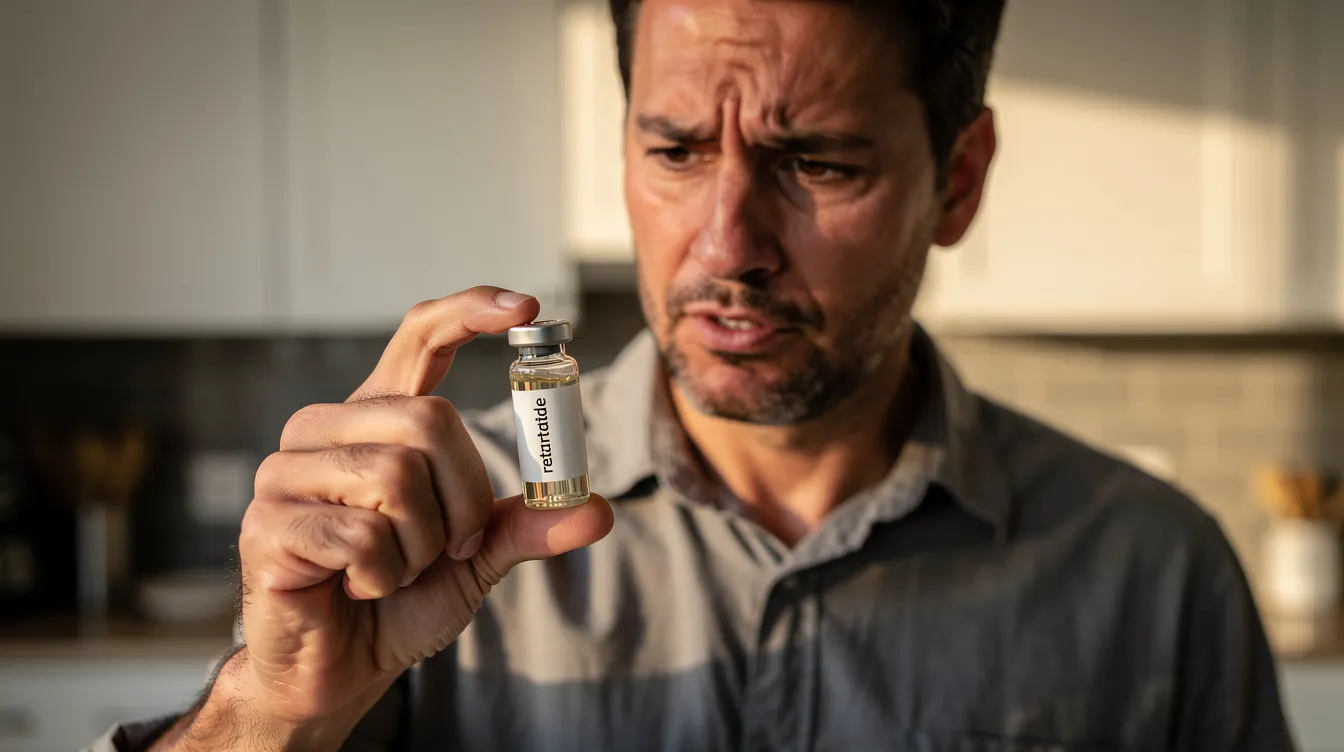



A photo can show a moment. It cannot show the patience, support, and judgment behind the change.
If you are searching retatrutide before and after, I get why the pictures pull you in.
A photo can make change look simple. One body on the left. Another body on the right. A caption about discipline, science, or finally finding the thing that worked.
But the picture usually leaves out the part I care about most.
It does not show the nights someone wanted to quit. It does not show the shame that built up before they asked for help. It does not show the medical screening, the side effects, the uncertainty, the patience, or the difference between legitimate care and shortcut sourcing.
And with retatrutide specifically, that missing context matters even more because Lilly’s retatrutide status page says retatrutide is still investigational, not FDA-approved, and legally available only through Lilly-sponsored clinical trials.
So this is not a hype piece. It is how I would read progress photos without letting hope turn into a bad decision.
Retatrutide Before and After: What Photos Cannot Tell You
Before-and-after photos of retatrutide can show visible weight loss, but they cannot prove safety, explain the medical context behind the change, or tell you whether the result would happen for you—and retatrutide is still investigational, not FDA-approved, and legally available only through Eli Lilly clinical trials.
That is also why these images can mislead people.
They compress months of behavior, support, biology, frustration, and medical judgment into two frames. Your brain fills in the blank space between them with whatever story you already want to believe.
If you feel stuck, the story might be, "That person found the thing I need."
If you feel ashamed, the story might be, "I should have done this sooner."
If you are exhausted from trying to lose weight the hard way, the story might be, "I just need access to the newest option."
That is where I want to slow the room down.
For adults in the U.S. exploring medically supervised weight loss, hormone optimization, or peptide-based treatment options, the useful question is not whether a picture looks dramatic. It is whether the claim behind it holds up under clinical evidence, medical supervision, realistic expectations, side-effect risk, FDA status, and the difference between trial data and social media progress posts.
What follows looks at the limits of retatrutide before-and-after photos, what clinical trial results do and do not mean, the safety and approval issues readers should understand, the role of lifestyle and monitoring, and how to judge online progress claims without mistaking them for evidence.
A photo can show a visible outcome. It cannot prove safety. It cannot prove that the source was legitimate. It cannot prove that a result would happen for you. It cannot show the health history, monitoring, nutrition structure, strength work, sleep changes, or support system behind the change.
For BMM, the better question is not whether a picture is impressive. The better question is whether it makes you more honest, more careful, and more willing to use a provider-reviewed path instead of a shortcut.
Why Transformation Photos Hit So Hard When You Feel Stuck

I understand why progress photos work on people.
When someone has tried to lose weight repeatedly, the problem stops feeling like a problem and starts feeling like a verdict. You do not just think, "My plan did not work." You start thinking, "Maybe I am the kind of person who does not follow through."
That is a brutal place to live.
I have built BMM around resilience because I know how quickly people confuse struggle with identity. You miss a workout and call yourself lazy. You regain weight and call yourself broken. You eat through stress and decide you have no discipline.
But discipline is not the same as pretending biology does not exist. Appetite pressure, food noise, stress, sleep, pain, medication history, and emotional eating can all make weight loss harder than the motivational version admits.
That is why a dramatic photo can feel like oxygen. It tells you change might still be possible.
I do not want to take that hope away from anyone. I just do not want hope to become gullibility.
The strongest version of you is not the version that believes every progress claim. It is the version that can look at a result, respect the possibility, and still ask, "What is the evidence? What is the status? What is the safest next step?"
That mindset is part of what I mean when I talk about resilience as something you build, not something you perform. I wrote more about that frame in the BMM guide to resilience symbols and meanings.
What Retatrutide Clinical Trials Results Can and Cannot Prove
Retatrutide has earned attention for a reason.
Lilly’s retatrutide status page describes retatrutide as an investigational triple hormone receptor agonist and once-weekly injectable medication that acts on GIP, GLP-1, and glucagon receptors, so it influences appetite, blood sugar, and energy expenditure at the same time. Unlike tirzepatide, which works on two hormones, retatrutide works on three. A phase 2 trial published in the New England Journal of Medicine reported that the highest-dose arm showed 24.2% weight loss after 48 weeks. In that study, 83% of participants lost at least 15% of their body weight. Lilly later announced positive phase 3 TRIUMPH-1 results in adults with obesity or overweight and at least one weight-related condition in its phase 3 announcement, and as of mid-2026 it remains in phase 3 clinical trials, with the FDA still considering it experimental.
That is real results from controlled trial findings, not social posts. Some observers see that as a sign retatrutide may outperform existing GLP-1 medications like semaglutide, but it still does not amount to a personal guarantee.
Clinical trials have eligibility rules, medical oversight, defined endpoints, and structured follow-up. Online progress photos usually give you none of that. You may not know the person’s starting health, other habits, adverse effects, what else changed, whether the image is even real, or whether the claim is being used to sell something.
Trial data can tell us that retatrutide is being studied seriously and has produced notable average results in controlled settings, with outcomes that include body weight reduction and possible metabolic health benefits such as reduced liver fat. It cannot tell a random reader what will happen in the first month, whether their side effects would be tolerable, whether they qualify for any study, or whether a social media source is safe.
Trials also found that more than 70% of pre-diabetic participants returned to normal blood sugar levels, A1c dropped by two or more percentage points in type 2 diabetes patients, and insulin sensitivity improved after treatment.
Broader measured outcomes also included reduced fasting plasma glucose and improved waist circumference.
That difference is not boring fine print. It is the line between education and self-experimentation.
The Part Photos Leave Out: Body Composition, Hunger, Habits, Patience, and Support
The fantasy version of weight loss is clean.
You find the right intervention. Hunger quiets down. The scale moves. Your identity catches up. Everyone notices. You never fight the old patterns again.
Real change is usually messier.
Even when medical support is appropriate, people still need structure. Trial-style support is not medication alone; it also includes healthy habits, lifestyle changes, diet, exercise, protein, walking, resistance training, sleep, stress management, follow-up, and a plan for the days when motivation does not show up. They still need to understand what they are doing and why.
Retatrutide trials included lifestyle counseling, which helps explain why the full picture is bigger than appearance or pounds lost.
This is where before-and-after photos can make people impatient. They show the visible payoff, not the invisible repetition.
They do not show someone choosing a normal meal when they wanted to punish themselves with restriction. They do not show someone walking after a bad day instead of waiting for a perfect day. They also do not show that progress can include fat loss, body composition shifts, and better health markers such as cholesterol reduction or liver function; after treatment, some patients also saw meaningful BMI reduction, improved mobility, and less knee arthritis pain, which can matter as much to daily life as how someone looks. They do not show the discomfort of asking a licensed professional for help after years of trying to solve everything alone.
That part matters to me because shame makes people vulnerable to shortcuts.
When you believe your body is proof that you failed, you become easier to sell to. Any source that promises speed, secrecy, or an easy door starts to look attractive. That is not weakness. It is what happens when pain and urgency take over the decision.
The work is to create enough space between hope and action that your next move can be grounded.
Here is the compliance reality I would keep in front of me.
Lilly’s retatrutide status page says retatrutide is not currently approved by the FDA, is still being evaluated in clinical trials, and is legally available only through Lilly’s clinical trials. Lilly also warns that people should not take products claiming to be retatrutide outside that setting.
The FDA’s GLP-1 warning page says unapproved GLP-1 products can be risky because they do not go through FDA review for safety, effectiveness, or quality before marketing. The FDA also says retatrutide cannot be used in compounding under federal law and warns against products falsely labeled for research use or not for human consumption.
That means I would not treat a retatrutide progress post like a shopping recommendation.
Retatrutide is not in the same category as a normal consumer treatment option right now. It is an investigational drug in clinical development. That does not mean all medical weight-loss care is impossible. It means this specific drug has a narrow current status, and the safest posture is education, legitimate provider guidance, and no gray-market sourcing.
If a page, post, or seller makes retatrutide sound like an ordinary checkout item, I would treat that as a red flag.
How I Would Read Online Progress Claims More Carefully

I would use a simple filter.
First, I would separate inspiration from evidence. A photo may motivate me, but it is not a medical source.
Second, I would ask what the post is trying to make me do. Is it educating me? Is it sending me to legitimate medical information? Or is it pushing urgency, secrecy, mystery sourcing, or a no-questions-asked checkout?
Third, I would look for missing context. Does the post mention provider oversight, study participation, adverse effects, lifestyle structure, or limitations? Or does it only show the outcome?
Fourth, I would refuse to use anonymous comments as a timeline. People love asking how fast something works because speed feels like certainty. But the honest answer is usually less satisfying: individual response varies, and the current public evidence does not make a safe month-one promise for a reader outside a trial. Treatment duration and dose can change outcomes, so a single photo or comment never gives the full picture. I also would not assume a post reflects how my own body adjusts or body adapts over time.
Fifth, I would watch my own emotions. If a photo makes me feel hopeful, that is fine. If it makes me feel desperate, I need to slow down before I click anything.
That is the mental muscle piece. Not cynicism. Judgment.
If you want a deeper medical education page on what progress claims can and cannot mean, Get Pep’d has a provider-reviewed retatrutide before-and-after guide.
A before-and-after search should move toward evidence, status clarity, and licensed provider review where appropriate. It should not move toward research-vial sourcing or social media timelines that hide the medical context.
That is the distinction BMM has to keep clean.
Education is useful. Shortcut hunting is dangerous.
If I were looking at retatrutide before-and-after photos and feeling pulled in, I would do five things before making the next move.
I would remind myself that a visible transformation is not the same as a safe path.
I would read the official status language from FDA and Lilly before trusting any seller, post, or comment thread.
I would stop looking for a first-month prediction. The first few weeks can look different from later progress, especially as the body adjusts. That question usually comes from urgency, and urgency is a bad decision-maker.
I would write down what I actually need help with: appetite, food noise, weight regain, emotional eating, low energy, pain, consistency, blood sugar concerns, or the shame loop that keeps restarting the same plan. It also helps to notice changes in cravings, reduced appetite, symptoms, or focus instead of only watching the scale.
Retatrutide remains active in the body for about six days, which is one reason dose decisions should not be treated casually. Then I would talk with a licensed professional about weight-loss support that is lawful and appropriate for my situation.
That does not make you weak. It means you are done pretending that the only options are white-knuckle discipline or a risky shortcut.
Progress photos can be motivating. They just should not be in charge.
FAQ and Side Effects
How much weight loss can you achieve in 1 month on retatrutide?
There is no safe consumer rule for how much weight someone can lose in one month on retatrutide. Lilly says retatrutide is investigational, not FDA-approved, and legally available only through Lilly-sponsored clinical trials.
The published and announced trial results are about groups of study participants over longer research periods. They should not be turned into a personal month-one promise. Starting weight affects pounds lost, so percentage-based results and absolute pounds can look very different from person to person, and not everyone will respond the same way. If a post or seller gives you a simple first-month number, I would treat that as a reason to be more skeptical, not less.
Does retatrutide work immediately?
I would not think about retatrutide as something that "works immediately," because that is the wrong frame: meaningful outcomes in research are measured over longer treatment duration, including reports approaching nearly 30% weight loss after one year. Think of it as a journey with gradual, milestone-based progress rather than instant change. Over that longer course, trials also reported significant cholesterol reduction along with improvements in blood pressure and LDL cholesterol levels. That does not mean you should assume rapid weight loss from day one, since early changes can include water weight while later progress reflects the longer process of losing fat. The drug is still being studied, and individual response in a clinical trial is not the same as a guarantee for the public.
More importantly, the current access reality comes first. Lilly says retatrutide is not FDA-approved, and the FDA says it cannot be lawfully compounded under current federal law, so it should not be treated like an ordinary product people can source online.
What to expect in week 1 of retatrutide?
For the general public, the honest answer is that you should not use online week-one stories as a plan. Under Lilly’s current status language, retatrutide is investigational and limited to Lilly clinical trials, where participants are screened and monitored. In studies, common side effects have included gastrointestinal issues such as nausea, diarrhea, constipation, along with fatigue and injection site reactions such as injection site redness or swelling. Nausea has been reported in a substantial share of participants in some study arms, which is one reason medical oversight matters. Reported side effects were typically mild to moderate. Serious symptoms can require prompt medical attention, including signs concerning for acute pancreatitis or gallstones. Transient ALT elevations have also been reported, so liver function monitoring belongs under medical supervision rather than self-experimentation. Heart rate should also be monitored as part of safety oversight when side effects are being assessed.
I would not trust a progress-photo caption, forum comment, or seller page to tell me what week one should feel like. Some people may notice increased energy early on, but reactions vary and it should not be assumed from online anecdotes. That kind of question belongs inside a legitimate clinical setting or a conversation with a licensed professional, such as a doctor or other healthcare provider, about lawful weight-loss options.
How soon after starting retatrutide do you start losing weight?
There is no provider-safe answer I would give as a personal timeline. Trial data can show that weight loss occurred in groups of participants under study conditions, and studies have reported about 24.2% weight loss after 48 weeks, but that reflects supervised group results rather than an exact personal timeline for one individual.
If the timeline question is really coming from impatience or shame, I would slow down. The better next step is not chasing the fastest claim. Support from a healthcare provider matters because dose, treatment duration, side effects, and lifestyle habits all shape outcomes, including changes in body weight, fat, and metabolic health. It is understanding retatrutide’s current investigational status and getting appropriate medical guidance for weight-loss support that is actually available and lawful, alongside healthy habits such as staying hydrated, diet, and exercise rather than treating medication as the whole answer.